Tuesday, February 25, 2014

Oh Hey Happiness, It's Been A Long-Time.

Let's talk happiness for a second. 

Imagine that the amazing Professor Ben-Shahar or Shawn Achor, both of Harvard University's Positive Psychology program asked
Tal Ben-Shahar
YOU to give a lecture to a group of students on how to create happiness, make decisions that will increase your happiness levels, and ways to predict how happy you will be in any given circumstance.


Shawn Achor

Maybe right now you have already formulated a speech in your mind that will be flawlessly delivered to the eager crowd of young students. They will hear your words of wisdom and leave the lecture hall feeling confident, optimistic and ridiculously more happy! 

                             Or maybe not...


Recent major personal life changes, decisions, and transitions have motived me to write this piece on happiness. I will be sure to update everybody on these big life changes in a blog very soon. 

Answer this quick question:
What do you have in your life right now that creates happiness for you?

My answer to this question contained items such as:

  • Good relationships
  • An amazing fiancĂ©
  • A great apartment
  • A wonderful doggie (love you Bipsy!)
  • A great job
  • Financial security
  • A nice car
  • Health insurance
And a few other things that came quickly to mind. 


Research shows that ONLY 10% of your long-term happiness is derived from these external factors.

There secret to 90% of your long-term happiness?
Answer: How your brain reacts to these external factors.


One of the biggest challenges with individuals and happiness today is that they believe they have absolutely no control over it.

When people lack certainty in their life and have an abundance of uncertainty, they are at a high risk of experiencing unhealthy amounts of anxiety. 

Unfortunately debilitating levels of anxiety and happiness can not exist at the same time. This is why many therapists have clients create a "positive thought jar". Individuals can not maintain a negative and positive thought in their minds at the same time. When you experience yourself focusing on a negative thought, go to your positive thought jar, and pull out a positive affirmation to combat the negative thinking. 

It is funny and maybe you know this, most individuals feel they have little control over their own happiness yet 90% is derived through a process that happens within you!


Stop predicting and start looking at the hard facts. 
Become a detective by taking some of your biggest stressors, successes, decisions, and relationships and begin dissecting what makes them stressful, exciting, negative, successful and/or challenging for you. 

This is worth the mental effort!
Take 10 minutes now to play detective and figure out how your brain reacts to the list you created above. 

YouTime's Summary:
It is important understand that happiness does not come from the external factors around you, it is created within you by the way your brain reacts to those external factors. 

The amount of expensive, lavish, and desirable possessions you have in your life is meaningless UNTIL your brain creates meaning for these things. The way your brain creates meaning to those possessions and relationships is unique to you. Take the time to understand yourself, your inner drives, and how you choose to react to your environment. 

It is your brain.
It is your happiness.
Take control.


For more information regarding research on happiness, please visit:
Http://goodthinkinc.com/research/


The Cloud Around You


Let me introduce you to my old friend "Pig-Pen".

Pig-Pen is special in many ways but as you notice he carries a cloud of dirt around with him. No matter how hard he tries to clean himself the cloud of dirt almost magically reappears. 
It is almost as if this individual is a magnet for dirt.

Individuals, like you and me, have the magnificent ability to attract specific things into our lives. Sometimes we invite genuine new friendships and connections, while other times we attract chaotic relationships and environments to live in.
You can almost say that humans have a magnetic field for these things. 

I am going to walk you through a map I came up with. This map will help you see if you and Pig-Pen have a couple things in common.


What drives human behavior?


EMOTIONS!
When your happy, ecstatic, and empowered you can accomplish amazing things at incredible speeds. At the same time, when you are sad, irritated, and aggravated an individual can cause detriment very quickly to themselves and those in their environment. Emotions drive us. It is our fuel, empowering and disempowering. 


What happens when you experience many emotions at one time?


Build-up, Suppression, and Inability to Properly Process
You all have most likely had a time in your life when you were experiencing multiple emotions at one time. Maybe at the time one emotion really stood out to you (anger, sadness...etc). Or possibly you felt confused and didn't know what to feel.


What does this put you at risk for?


"Emotional Clutter"
Emotional Clutter are the thoughts, beliefs, events, memories, experiences, and feedback that we have received or been through in the past that have not passed through us but have simply become stuck in our mind and body.


Who does this affect?
1. You
2. The individuals around you


Is the "cloud" always visible to us?
No, not at all. Ever feel like you have "processed" or "gotten past" something and one day it creeps back into your life? Well, that is simply the "cloud" rearing its invisible ugly head. 


What does it affect?
This cloud will filter and affect;
1. Everything we think about (our mental focus).
2. Everyone we meet (and the type of people we meet).
3. What we do (and what we don't do).


3 Things You Must Know About "Emotional Clutter"
1. Our "cloud" can combine with other people's clouds (others perceptions, agendas, world views).
2. Our "cloud" attracts more clutter (from friends, family, new connections, environments).
3. Our "cloud" leaves debris for others to pick up


One Opposing Force to "Emotional Clutter"
The Law of Attraction:
"Like attracts Like"
Events are attracted by you and the energy that you send out to the world, the environment you exist in, and the people around you. Individuals receive the positive or negative energy you send out. In order to oppose Pig-Pen's magnetic attraction for dirt, he must focus and manifest positive energy to getting clean. 

In human talk, take some time to really think hard about what you want, your intentions behind it, and ask for it!


2 More Techniques to Release the "Clutter"
1. Find one behavior to release
 What is one negative behavior you feel safe and secure releasing? Find one and focus on just that.

2. Focus on the process more then the outcome.
It is simple for most to identify where they would like to be in life. Sometimes requiring a little bit of thought. What many people don't realize is that the process to get their is just as, if not more important than the outcome. 

"Emotional Clutter" is made up of individual strands. Focus on the individual strands to detangle the "clutter". Maintaining focus on the entire "cloud" will become overwhelming, stress inducing, and harmful to your success. 


I think we both can see the smile on Pig-Pen's cloudless face now.


Resources for your "Emotional Clutter":


Thanks for reading!

All the Best,

Jonathan


Sunday, February 16, 2014

Living Life Through Quotes

A good quote can motivate somebody to try something new, persist through tough times, or make necessary changes in their life. Quotes are so powerful because they embody an entire mindset, image, story, and lifestyle within one single sentence.

In my perspective, what makes a quote set itself apart is if it actually motivates you to take action with your life simply by the burning desire it ignited in you. Sounds powerful and somewhat unbelievable, huh? It happens and it will right now.

Following the quotes below will include a very small and incredibly manageable exercise to complete. Do this and consider you day a success.


1.
Dreams, Motivation, Schedule, Goals

Exercise: Since scheduling makes it real, lets schedule! Think about something that you enjoy doing,  that is positive for you, or brings you great vibes and schedule it for the very near future. Set this in your calendar, with as many reminds as possible, and lets make this real!


2. 
Consistent, Constant, Commitment, Dreams, Regret, Simplistic

Exercise: Keep it simple stupid. What we are constant and consistent with, as simple as it sounds, is what makes the real difference. Choose something right now, that is once again extremely manageable and positive (requires minimal time, minimal resources, and minimal excuses) and agree to do it every day for 30 days. Some people may choose taking one deep breath a day, drinking a glass of water in the morning, or saying hello to one stranger. 
Whatever you choose, stay consistent and constant.


3. 
Love


Exercise: For this exercise, I want you to do two things.
First, write down something you love doing.
Second, write down something you could do with more love. 


4. 
Being wrong, life, creativity

Exercise: Wrong? Never! For this exercise I want you to write down or state out loud something that you have been wrong about. After all, we all have been wrong at some point in our life. 


5. 
Expectations, Appreciation, happiness

Exercise: If you don't appreciate what life has offered you, you begin to take it for granted. Write down 5 things that you appreciate in your life (if you have more then 5 keep the list going!).


Congratulations! If you followed the exercises then you have had one successful day.

Take this message with you,

Live your life by continuing to grow through your actions, being consistent, appreciating everything, not fearing being wrong, and most of all, live your life with love.


Friday, February 7, 2014

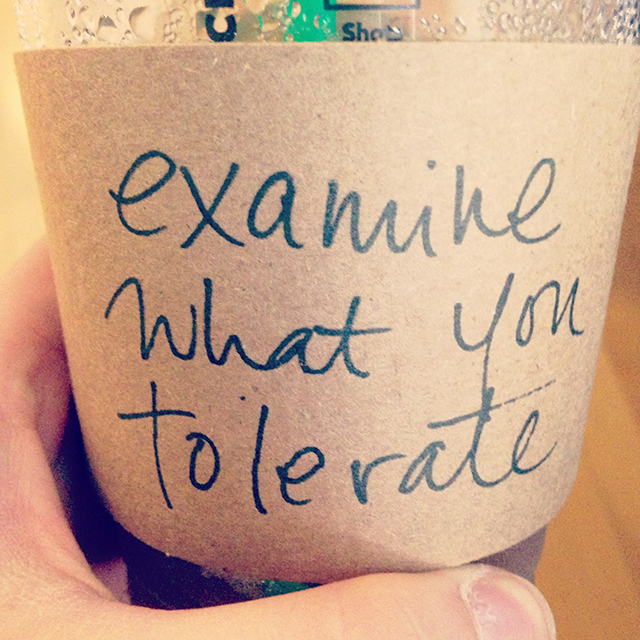
Examine What You Tolerate

On Pinterest you can find nearly anything. From wedding ideas, workout routines, recipes, cute animal pictures, to quotes. If I had a specialty on Pinterest it would be finding unique, meaningful, and stimulating quotes to sit down and really think about (maybe even do something about). I know half of the population on social media believes, they are the quote gurus! I say, there can be many gurus.

I came across a quote a while back,


After reading this I thought for a moment about myself and some of the things that I allow to "slide by" throughout my day and week. What really grabbed me though, as seen through the work I do with clients, is that people tolerate very toxic things in their lives. 

"Examine what you tolerate". In other words, take a deeper look at what things you allow to exist, occur, and be done within your own life that you have convinced yourself are for your best interest. i

Individuals choose to tolerate a wide range of things in their lives that are believed to be for your benefit but are actually toxic to your life. 

Major "tolerated" toxic events;
  • Having friends that put you down
  • Being lied to frequently
  • Being in a relationship that is abusive (verbal, physical, sexually, and neglectful)
  • Negative treatment because "you are not good enough"
  • Bullying because "you deserve it"
  • Consistently giving up on going to the gym or your diet because it "won't make a difference"
  • Bad habits (tolerated by the individual with the habit and others in their environment)
People tolerate all types of things as result of low self-worth and image, fear of others reactions, fear of "not being good enough", fear of "the unknown and uncertainty", the perceived consequences of not tolerating the event, and conditioning to tolerate these events from prior relationships. 

This month set-up an appointment with yourself for a real gut check. Ask yourself what types of things do you tolerate that may be limiting you and why do you tolerate them? 

We all have our faults, imperfections, bad habits, and things to work on. Let's start by being your own detective and asking these four questions.

  1. What are the incredibly obvious things I tolerate in my life right now?
  2. What are the tougher, more painful, and complicated pieces that you tolerate in your life? (true gut check)
  3. What is the cost of continuing to tolerate these things?
  4. What is the benefit of taking steps to stop tolerating these events?

When working on some of the events I have mentioned above you want to be under the supervision of a trained Mental Health Professional. If you feel as though this is the time make some of those changes use the link below. 


Find a Therapist: Find a Therapist near you

Friday, November 15, 2013

The Rich Kid Has Problems Too

If your child experiences poverty before the age of 5 research shows that there are serious negative outcomes that will most likely be coming their way. These negative affects could results in:

  1. Protracted Stress (long-term)
  2. Behavioral Issues (conduct disorder, anger regulation issues, getting into fights...etc)
  3. Social Problems (social anxiety, body image issues, giving into peer pressure, bullying...etc)
  4. Emotional Problems (depression, anxiety...etc)

Does this mean that American's are forced to make more money in order to ensure that their child will grow up to be "normal". The short answer, NOPE. I am afraid to say ladies and gentlemen but, 
MONEY IS NOT THE ANSWER
Before getting into this next section I would like to take a second to say that the facts, findings, research, and opinions expressed are not to minimize or criticize any individual's parenting. The following is used to serve as a platform for discussion and questioning on this very important topic. Parenting is an extremely arduous process and by no means has anybody perfected it. I applaud parents that try their best with what they are given and can ask for help when necessary. I hope these findings allow you to ask the important questions to help your family, friends family, and children. 


Recent research is showing significant increases in the social, emotional, and behavioral disturbances of the children that come from affluent families. Kids that come from families that make $150,000+ (over 2x the national average), have parents in high-status careers, attend the most prestigious schools, and have well-educated parents are at risk now too.

Some of the findings of this research shows that kids coming from affluent families are at risk for:
  1. Substance abuse (high alcohol use, binge-drinking, marijuana use, and other hard drugs)
  2. Delinquency from school 
  3. Wide-spread cheating
  4. Stealing from parents or peers
  5. Maladjustment in school and social environments


A common misconception amongst affluent parents, and this is reinforced my many sources of media, is that money and education will prevent these events from happening or even solve them.

"If facts alone were enough to change an individual's behavior long-term, then there would be no overeating, alcohol abuse, cigarette smoking, or drug use. There needs to be more then just the facts."


YOUR OPINION

WHAT IS CAUSING THIS?
I want your opinion.

Share your thoughts below as to why children coming from affluent families may be experiencing more depression, anxiety, social problems, and substance abuse issues then before.

Some questions to think about:
  • Why is this happening to kids coming from affluent families?
  • Why is the magic school year 7th grade for most of these issues to present themselves? 
  • Are you experiencing these issues? If so, how has the experience affected your family and what words can you offer others?


In the next blog, I will share with you the findings of some on-going research that breaks down why this may be happening and how to fix it.


Tuesday, August 20, 2013

ABC Is As Easy As 123

Dr. John Norcross is a Professor of Psychology & Psychiatry as well as an expert on changing human behavior. With over 30 years of backed research the "Stages of Change" have been developed and have helped thousands of individual see sustainable personal/professional change. 

Change

Stemming from research based out of my undergraduate alma mater, University of Rhode Island, the "Trans-theoretical Model" became the go to formula for successful change.


One aspect of change is to conduct a little detective work in identifying what may be wrong and why it is happening in the first place. This is commonly referred to as your "Behavioral Chain". 

Behavior, Antecedent, Consequence, Change, Behavioral Chain

A Little Bit About the ABC's


Antecedents
  • Occurs prior to the event and may trigger you to act a particular way. 
  • Can include your environment, the people around you, the interaction with the individuals with you, and your mood. 
  • Some detective questioning could include; Who are you with when you experience this behavior? What mood are you in when this behavior presents itself (sad, stressed, happy, bored, anxious...etc)? What time of day does this behavior typically come out (morning, day, night)?

Behavior
  • The problem behavior
  • Also, the healthy alternatives to the problem behavior.

Consequence
  • Occur after the problem and usually rely on what the specific problem is. 
  • *BEWARE* Short-term consequences can be very rewarding (taste good, relaxing...etc)
  • *BEWARE* Long-term consequences can be painful and destructive (heart disease, stroke, cancers, obesity, diabetes...etc)
  • We favor instant gratification rather then delayed gratification.
  • Recording long-term consequences is just as important as recording the short-term.

A few tips on how to use the ABC's to change your behavior
  1. Explore the antecedents to your behavior and find healthy alternative environments and social groups to prevent triggers that promote your problem behavior.
  2. Create new healthier alternatives and substitutes to meet your need for variety, fun, and freedom. Learn a new relaxation technique or coping skills to get you through triggering antecedents. 
  3. Reverse the consequence to your problem behavior and work backward through the ABC's to see what new antecedents and behaviors are necessary to end up with this new outcome. 

Check out this great worksheet for your 
ABC's and behavioral chain:


Secrets to Change, Socrates, Beliefs


*Derived from Changeology By: John Norcross, PhD